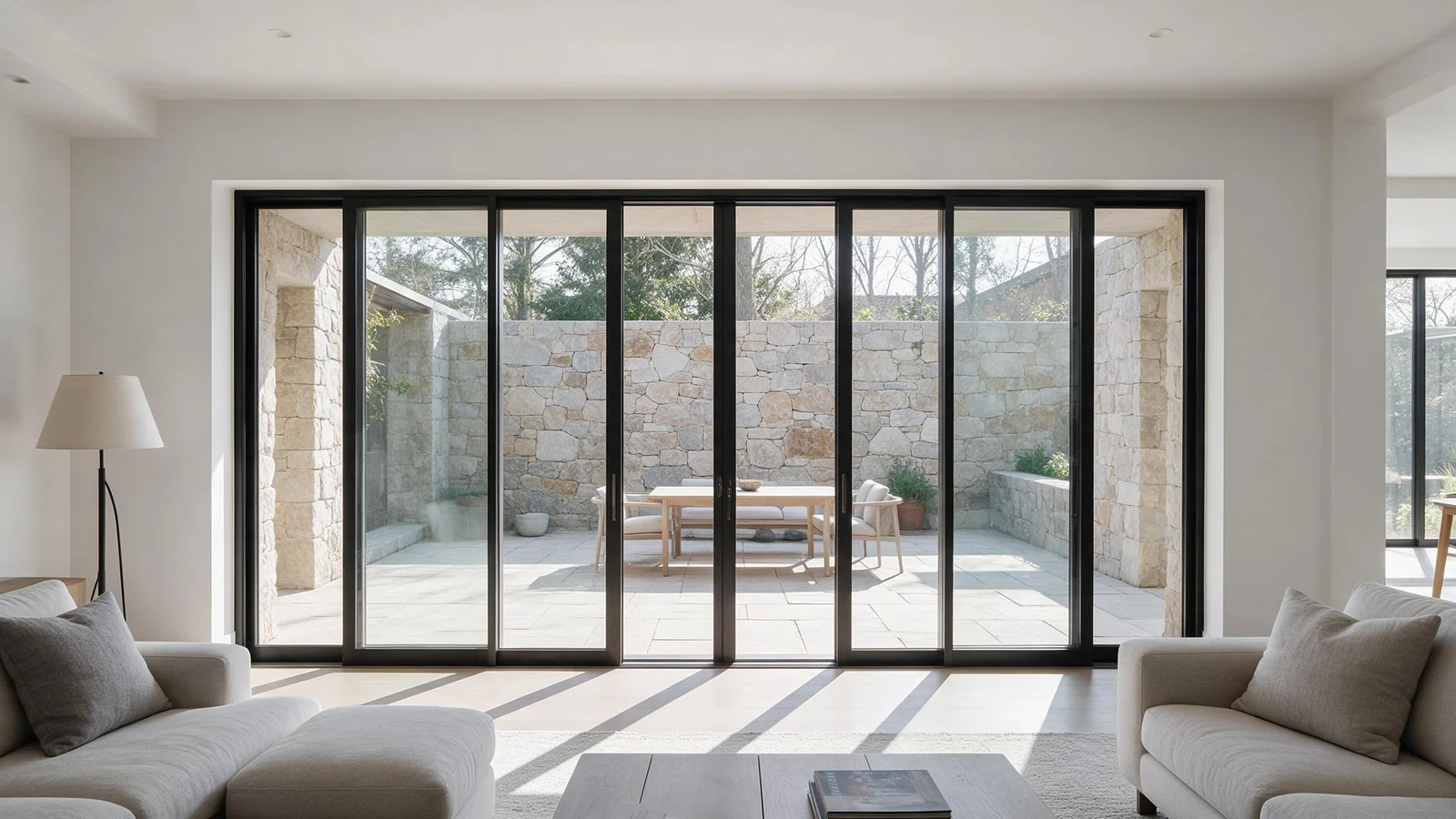
Most sliding glass doors sold in North America come in a handful of stock sizes. You pick the closest one, then frame the opening around it. That works fine for a tract house. It doesn't work when you're matching an existing opening, fitting a wall you can't change, or trying to hit a specific sightline.
Custom sliding glass doors flip the process. You measure the rough opening. The factory builds the door to that number. No SKU list, no compromise on width.
What Counts as a Custom Sliding Glass Door
The line between stock and custom is simple. A stock door is manufactured to a catalogue size and shipped to a warehouse. A custom door is manufactured to your rough opening, which means the drawing and the opening drive the build, not a fixed size chart.
That distinction matters more than most buyers realize. If your opening is wider than the closest stock door, you're either reframing the wall or living with a gap. A custom order removes that problem.
Custom orders can cover the main sliding door types:
- Sliding patio door - two panels, one fixed and one sliding, or two sliding panels.
- Lift-and-slide - the panel lifts slightly before it rolls, which makes large, heavy sashes easier to move. Our 170 series aluminum lifting and sliding door is built this way.
- Multi-panel - three, four or more panels on multiple tracks.
- Oversized patio doors - openings wider than a single panel can reasonably span.
Frame material is another choice. Thermally broken aluminum gives you slim sightlines and won't rot or warp. Aluminum-clad wood puts a solid wood surface on the inside and a weather-resistant aluminum skin on the outside. Both are available for custom builds.
What You Can Customize: Size, Panels, Glass, Finish and Hardware
Size is the obvious one. We build to your rough opening, so the finished unit is sized to the opening rather than a catalogue number. If you're ordering a custom unit, the opening is the number we need.
Panel count and opening direction come next. Two-panel configurations are the default for most patio doors. Multi-panel layouts work when you want a wider glass wall. You can also specify a stationary panel if you want more glass without more moving parts.
Glass is where a lot of the performance lives. Insulated and triple-glazed build-ups are available, along with Low-E coatings and built-in blinds on the series that support them. The 170 series lifting and sliding door uses 5+12A+5+12A+5 triple glass. Narrow-frame sliding doors run Uw 2.0 and Rw 25. The 170 series carries sound insulation above 30 dB.
Finish and hardware round out the list. Aluminum frames get powder-coated in a range of colors. Aluminum-clad wood gives you a solid wood interior with an aluminum exterior. Hardware brands we work with include ROTO, SIEGENIA, CMECH, Kinlong, Hoppe, VBH and G-U. If you have a preference, say so when you send your enquiry.
How to Measure and Submit Your Opening
Measure the rough opening, not the old door. That's the single most common mistake. The old door might be undersized, out of square, or sitting on a shim pack that's been there for twenty years.
Take the width at the top, middle and bottom of the opening. Take the height at the left, center and right. Use the smallest figure in each direction. If the opening is out of square by more than a quarter inch, note it. The factory needs to know.
The finished unit will be slightly smaller than the rough opening. That gap is for shimming and squaring during installation. It's normal, and it's why the opening is the number that matters.
What to send with your enquiry:
- A dimensioned drawing or a clear sketch
- Opening width and height
- Panel count and opening direction
- Glass choice
- Finish and hardware preference
For oversized patio doors, flag the opening width early. If the opening is wider than a single panel can span, the factory will advise on a mullion-combined multi-panel unit instead of one giant sash. That's a structural decision, not an aesthetic one.
Quote, Lead Time and Order Process
Send your project details and we aim to return a quote within 3 hours on average. That's not a guarantee, but it's the target.
Production usually takes 25-30 business days depending on design, materials and order volume. Payment is by bank transfer or T/T. Trade terms include EXW, FOB and CIF.
Sample orders are supported before a bulk purchase. The minimum order is 2 square meters. If you're a builder or dealer testing a new supplier, a sample order is the low-risk way to check the build quality before committing to a full project.
Certifications and Performance to Ask About
Certifications matter, but only if they cover the exact product you're buying. Our NFRC certification covers sliding doors, and our 170 series aluminum lifting and sliding door is ENERGY STAR certified.
At the company level, we hold ISO 9001, CSA and ETL certifications. The broader list includes AAMA/WDMA/CSA, CE, ISO 14001 and ISO 45001.
When you're comparing suppliers, ask for the certificate number and the test report that matches the exact series being quoted. A certification that covers a different series doesn't help you. The NFRC Certified Products Directory lets you filter by product type and features to confirm what's actually certified.
The NFRC label provides energy performance ratings in multiple categories. U-Factor measures how well a product keeps heat from escaping a room, and the lower the number the better. On the NFRC door label, each rating is split into two values: Solar Heat Gain and U-Factor.
One more thing to check: 16 CFR Part 1201, the Safety Standard for Architectural Glazing Materials, covers sliding glass doors (patio-type). It's issued by the Consumer Product Safety Commission, and it's designed to reduce or eliminate unreasonable risks of death or serious injury. Any supplier selling into the US should know this standard applies.
Factory-Direct Support: What You Get and What You Don't
We're an export factory in Foshan, China. We don't provide overseas installation. What we do provide is an installation manual, a video tutorial and remote technical support. For large-volume engineering orders, a technical team can be arranged to guide installation, subject to separate negotiation.
Our production facility covers 20,376 m² (219,325 sq ft). We run 15 production lines with 18 R&D engineers and 13 QA/QC inspectors. WANJIA Hiseng is part of Foshan WANJIA Window and Door Co., Ltd, registered in 2012, with 14 years of exporting experience.
Warranty depends on the specific product and contract terms. Repair or replacement is available during the warranty period. Ask for the details in writing before you order.
What you won't get from a factory-direct order: a showroom to walk through, a local installation crew, or a published price list. If those things matter to you, a domestic dealer is a better fit. If you know what you want and you're comfortable working from drawings, factory-direct saves money and gives you more control over the build.
Custom Sliding Glass Door FAQ
Who makes custom size patio doors?
Manufacturers who build to order rather than to a stock size list. That includes factory-direct suppliers like WANJIA Hiseng, as well as domestic custom shops. The difference is where the door is made and how the order is placed. A factory-direct order means you send a drawing and opening dimensions, and the factory builds to them.
Can I get custom-sized sliding doors for my exact opening?
Yes. That's the point of a custom order. You measure the rough opening, send the dimensions, and the factory builds the door to fit. The finished unit will be slightly smaller than the opening to allow for shimming and squaring. The opening is the number the factory needs, not the old door size.
What is the average cost to have a sliding glass door installed?
We can't give you a number, because installation costs vary by region, opening condition and local labor rates. What we can tell you is that we don't provide overseas installation. We supply an installation manual, a video tutorial and remote technical support. For large-volume engineering orders, a technical team can be arranged to guide installation, subject to separate negotiation.
How long does a custom sliding glass door take to manufacture and ship?
Production usually takes 25-30 business days depending on design, materials and order volume. Shipping time depends on your location and the trade term you choose. We'll give you a tracking number after shipment.
Related Pages
If you're still weighing options, these pages go deeper on specific questions.
- Custom sliding doors - the full range of what we build to order.
- Aluminum sliding door manufacturers - how to compare suppliers.
- Black sliding glass doors - finish options and what they look like in practice.
- Sliding glass door dimensions - standard sizes and how they compare to custom.
Ready to move? Send us your opening dimensions and we'll get back to you with a quote.