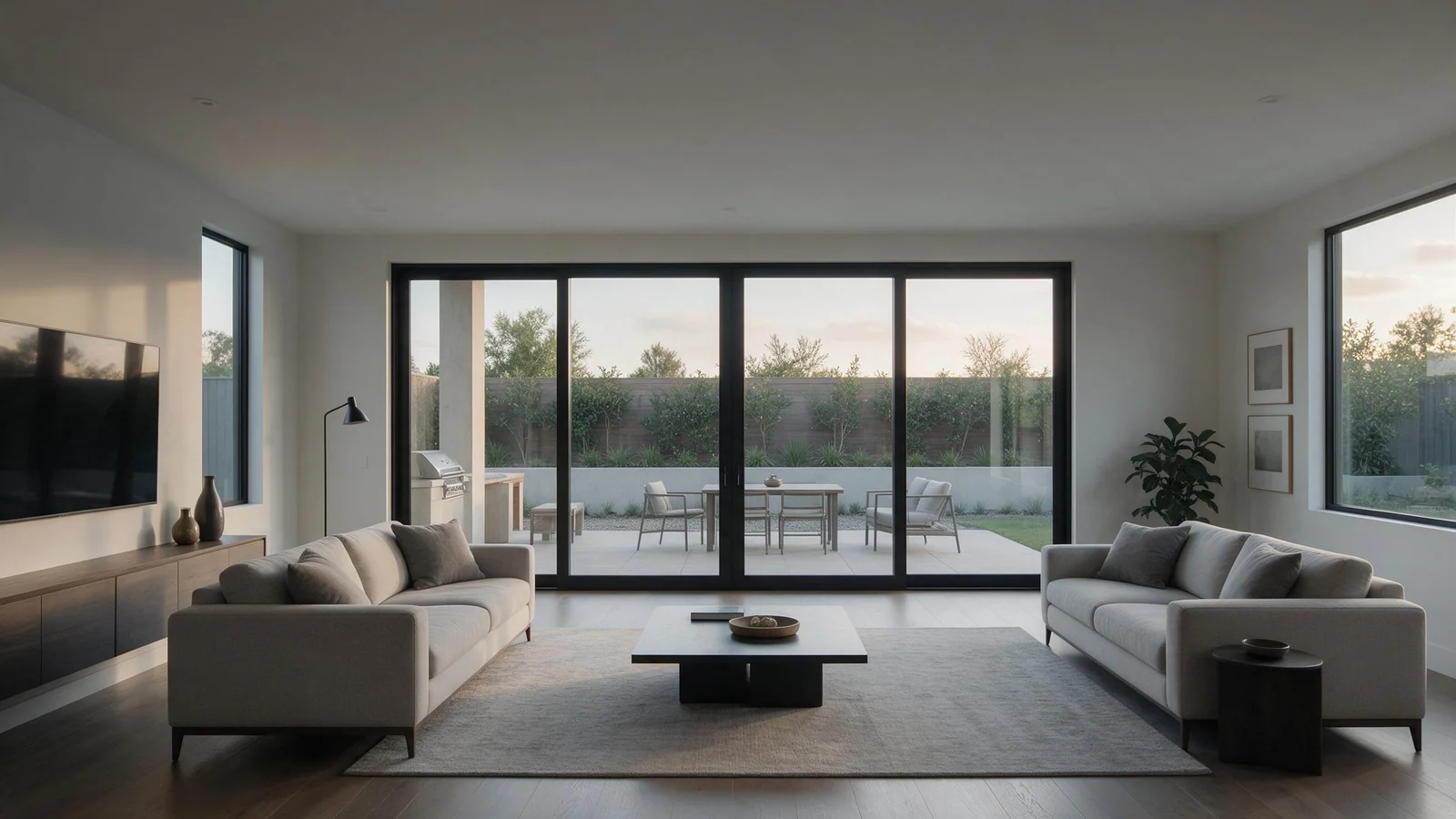
You're standing in a kitchen, looking at a wall that should be glass. Or you're a builder with a set of drawings and a client who wants the patio to feel like part of the living room. Either way, the question is the same: what makes the best sliding doors the right choice, and how do you compare one against another without getting lost in catalog language?
Sliding doors glide horizontally on a track. No swing clearance needed. That suits compact rooms and open-plan layouts where a hinged door would eat a corner. They also maximize glass area. Compared with hinged or French doors, a slider gives you more visible glass per foot of opening, and more daylight lands on the floor. That said, sliding doors are one option among several patio door types. The right choice depends on opening width, traffic flow and climate.
What Makes a Sliding Door the Best Choice for Your Opening
A slider works best when the opening is wide and the room behind it is tight. Picture a galley kitchen that opens to a deck. A hinged door needs a clear arc of floor to swing through. A slider just needs a straight run of track. That difference matters in a condo, a narrow dining room, or any wall where furniture sits close to the glass.
Traffic flow is the second question. If people move through the opening constantly, a slider with a low-profile track and smooth rollers keeps the path clear. If the opening is mostly a view, one large fixed panel with a single operating sash gives you the glass without the hardware cost.
Climate is the third. In a cold market, the frame and glass do more work than the door style. A thermally broken slider with triple glazing will outperform a thin-framed slider with double glazing, even if the second one looks better on a showroom floor. That trade-off is real. Name it early.
A slider is not the only way to open a wall, though. Bi-fold doors fold panels to the side and clear a wider span. French doors swing and suit traditional facades. We keep a separate guide on sliding doors vs French doors if you're still deciding between the two.
Best Sliding Door Materials: Aluminum, Aluminum-Clad Wood, and Others
Material choice drives durability, maintenance, and how well the door performs in cold or coastal climates. Three options come up most often.
Aluminum
Aluminum frames are strong and slim, so you get more glass and less visible frame. Thermal performance is the catch. Aluminum conducts heat, so a plain aluminum frame will bleed warmth in winter and cool air in summer. The fix is a thermal break: a non-conductive section that separates the inner and outer frame. Without it, the door fights your HVAC system all year.
Our 170 series aluminum lifting and sliding door uses a 2.2 mm frame and 5+12A+5+12A+5 triple glazing, with sound insulation above 30 dB. The narrow-frame sliding door is rated Uw 2.0 and Rw 25 dB. Those are the numbers we publish for those series. And they're the numbers you should ask any supplier to match on paper.
Aluminum-Clad Wood
Aluminum-clad wood combines a solid wood inner frame with a protective aluminum outer shell. You get the warmth of wood on the inside and the weather resistance of aluminum on the outside. It's a good fit for a living room or a master bedroom where the interior finish matters as much as the exterior.
Our aluminum-clad wood sliding doors use a 6063-T5 aluminum clad wood profile, with American oak as the standard wood. Hardware options include ROTO, SIEGENIA, and CMECH. The 304SS aluminum mesh screen is available if insects are a concern. The materials are recyclable, which matters to some buyers and not at all to others. Either way, it's a fact, not a slogan.
Other Materials
Vinyl and fiberglass exist, and they have their own trade-offs. We don't make them, so we won't pretend to rank them. What we can say is that the frame material should match the climate and the maintenance budget. A coastal project with salt air will punish a frame that isn't built for it.
Glass, Thermal Break and Hardware: What Actually Drives Performance
Glass is where most of the heat moves. Insulating glass build-ups such as 5+12A+5+12A+5 triple glazing and Low-E coatings reduce heat loss and noise. Those numbers in the build-up are not decoration. They tell you the glass thickness, the air space and the coating. A 5+12A+5+12A+5 unit is two air spaces and three panes. That's a different product from a simple double-glazed unit, and it performs differently.
A multi-chamber thermal break profile separates the inner and outer frame to cut conduction. Think of it as a bridge with a gap in the middle. Heat has to cross the gap. It doesn't want to. The more chambers and the better the break, the less energy you lose.
Hardware from ROTO, SIEGENIA, CMECH, HOPPE, Kinlong, VBH or G-U supports smooth operation and multi-point locking. On a slider, the rollers and the track matter as much as the lock. A heavy sash on cheap rollers will drag within a year. Ask what brand the rollers are, and ask how the sash is adjusted after installation. If the answer is vague, that's your answer.
Security is its own topic. ASTM F842 covers standard test methods for measuring the forced entry resistance of sliding door assemblies, excluding glazing impact. The standard defines types: Type A locks to the jamb, Type B locks to an intermediate jamb, Type C panels abut and lock to other panels, and Type D is a fixed panel. It also notes that resistance to higher levels of force from a skilled burglary attack requires methods such as alarms, communication systems, or special security glazing. In plain terms: a good lock helps, but it's not a vault. For a deeper look, see our notes on how to secure a sliding glass door.
Sliding Doors vs French Doors vs Bi-Fold Doors
Sliding doors need no swing space and have fewer moving parts than folding systems. That simplicity is the point. Fewer hinges, fewer tracks, fewer things to adjust. A slider is also easier to screen, which matters in mosquito country.
French doors swing open and suit traditional facades, but they need floor clearance. In a tight room, that clearance is a real cost. Our K80 large entrance aluminum double casement doors are rated Uw 1.4 and Rw 37 dB, with 5+16A+5+12A+5 triple glazing up to 8+27A+8, a 35.3 mm multi-chamber thermal break, and Kinlong hardware as standard with Hoppe, Cmech, VBH and G-U as options. Built-in blinds are available in manual, magnetic or electric versions. The unequal double casement door is rated Uw 2.6 and Rw 32 dB with 5+19A+5 glass. Those are the K80 numbers, and they belong to that series, not to a slider.
Bi-fold doors open a wider clear span but add more hardware and maintenance. Our aluminum folding door series 68, 75, 80 and 88 use a bottom sliding system that can bear up to 400 KG. The 88 series modern accordion folding glass door is ENERGY STAR certified, with a 2.0 mm profile, 2.2 mm local reinforcement, sash width 500-900 mm and height 1900-3000 mm, 5+27A+5 tempered insulated glass, and hardware options including Kinlong as standard plus Hoppe, Cmech, VBH and G-U. If you want the folding route, start with folding patio doors.
| Type | Swing clearance | Glass area | Moving parts | Best for |
|---|---|---|---|---|
| Sliding | None | High | Few | Tight rooms, wide views |
| French | Yes | Medium | Moderate | Traditional facades |
| Bi-fold | Minimal | High | Many | Wide clear spans |
Choosing Sliding Doors for Cold Climates and Energy Codes
Cold-climate buyers should prioritize thermally broken frames, triple glazing and warm-edge spacers. Warm-edge spacers reduce conduction at the edge of the glass. That's where a lot of heat escapes. Small component. Large effect.
Ask for the NFRC certificate number and confirm it names the exact sliding door series being quoted. This is the step most buyers skip. A certificate that covers a casement window does not cover a sliding door, and a certificate that covers one series does not automatically cover another, so the North American Fenestration Standard, published by AAMA, WDMA and CSA, is where you check. The 2022 edition of AAMA/WDMA/CSA 101/I.S.2/A440 has been published and replaces the 2017 edition, and the 2017 standard is referenced in the 2021 editions of the International Building Code and International Residential Code, with the 2022 standard proposed for the 2024 editions. In NAFS-22, the Limited Water (LW) rating and designations for sliding doors were added for consistency across all door products. Useful if water performance is on your checklist.
Our sliding door range includes NFRC-certified series, and the 170 series aluminum lifting and sliding door is ENERGY STAR certified. We can name the certificate coverage for sliding doors. If a supplier can't name the series on the certificate, notice that.
Specifying and Ordering Sliding Doors from a Factory
Send opening sizes, drawings, quantity, glass and hardware preferences and the factory can quote accurately. Custom sizes get made to the rough opening instead of pulled from stock. So the finished unit comes in smaller than the opening, which leaves you room for shimming and sealing. Measure the opening in three places. Use the smallest number. That one habit prevents most fit problems.
What to send: a dimensioned drawing or a clear photo with measurements, the quantity, the glass build-up you want, the hardware brand if you have a preference, and the finish. If you have a U-value target, say so. If you're working to a code, name the code. The more specific the input, the faster the quote.
Production lead time is typically 25-30 business days, and that depends on the design, the materials and the order volume. Quotes usually come back within 3 hours after we receive project details. Warranty depends on the specific product and contract terms and covers repair or replacement during the warranty period. We provide an installation video, written guidance and remote technical support, and our technical team can help with measurement.
If you're a dealer or a builder comparing a factory-direct supplier against a brand-name door, put both on the same specification sheet. Ask for the NFRC certificate number, the series name, the glass build-up, and the hardware brand. If one side can't answer that, you have your comparison.
Sliding Door FAQ
What are the best sliding door brands? There is no single answer, and any list that names one is selling something. Look at the ratings on the label, the hardware brand, the glass build-up, the frame material and the service terms. A door is a system, not a logo.
What kind of sliding glass door is best? It depends on your climate and your opening. In a cold market, a thermally broken frame with triple glazing and a warm-edge spacer will outperform a thin frame with double glazing. In a mild climate, a simpler build-up may be enough. Match the door to the conditions, not to a trend.
What is the average cost of a new sliding door? Cost depends on size, glass, hardware and quantity rather than a single list price. A large triple-glazed unit with premium hardware costs more than a standard double-glazed unit. Ask for a quote against your actual opening, not a catalog range.
If you're ready to move, get a quote and send your opening sizes. We'll tell you what we can do and what it takes.