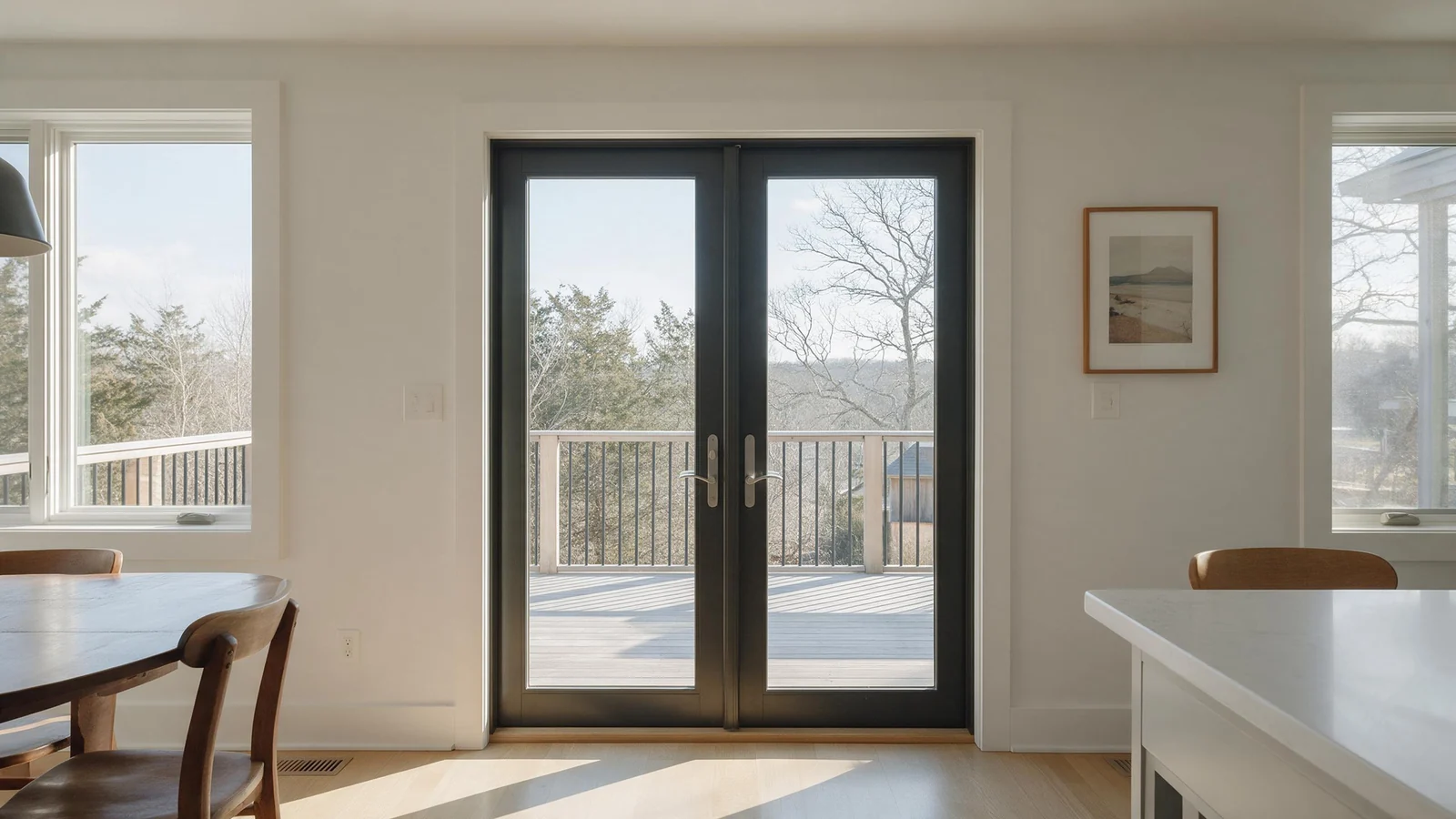
Most pages about french doors installed cost give you a single number and move on. That number is useless. It hides the door, the freight, the duty, the carpenter, the drywall repair and the permit behind one figure, and none of those line items behave the same way.
So let's pull it apart. If you're a builder, a dealer or a homeowner replacing a rear opening, you need to know which part of the total a factory controls and which part it doesn't. That's the whole point of this page.
What 'French Doors Installed Cost' Actually Includes
Four buckets. Door unit, freight and duty, local labour, site work. They stack in that order, and only the first one comes from us.
The door unit
This is the frame, sashes, glass, hardware, factory finish and packing. When WANJIA Hiseng quotes a french door, this is what you're buying. Options sit inside this bucket too: glazing upgrades, hardware brands, built-in blinds, screen options.
Freight and duty
We ship from Foshan, and the ports we use are Guangzhou, Foshan and Shenzhen. Trade terms are EXW, FOB or CIF, so how far the freight cost travels with the door depends on which term you pick. Duty and customs clearance sit on your side of the water.
Local labour
Your installer, your market, your rate. A crew in Toronto and a crew in rural Montana don't charge the same, and no factory can quote that for you.
Site work
Pulling the old door, patching stucco, reframing a rough opening that's out of square, adding a header, touching up paint, pulling a permit. Say a 1980s house has a settled slab and the old threshold sits 3/4 in out of level. That's a carpenter's problem, not a door problem, and it lands in this bucket.
One more thing that catches people. We send an installation video and written guidance after the goods arrive, plus remote assistance until the project is finished, and our technical team can work through a measurement solution with you. That's support, not a crew. Budget for your own labour.
How Much Do French Doors Cost? Budget, Mid-Range and High-End
We won't publish dollar figures, and you should be suspicious of any factory that does. Prices move with aluminium, glass and freight, and a number written last quarter is wrong this quarter. What we can do is explain why the tiers exist, because the material logic is stable even when the price isn't.
Budget tier. Hollow or thin-wall aluminium, a single glazed or basic double glazed unit, builder-grade hardware, minimal thermal break. Fine for an interior opening in a mild climate. Won't hold up on an exposed west-facing wall in a cold zone.
Mid-range. This is where aluminium sits. Proper thermal break, insulated glazing, branded hardware, powder coat finish. It's the workhorse of the category, and it's what most North American builders spec when the client wants low maintenance and a modern profile.
High-end. Aluminium-clad wood lands here, and so does a heavy aluminium entrance door built to a high thermal spec. You're paying for the profile depth, the glazing build-up, the hardware and the finish quality. Our K80 large entrance aluminium double casement door is a good example of the top of the aluminium range: 35.3 mm multi-chamber thermal break profile, Uw 1.4 W/m²K, Rw 37 dB.
Two things push any tier upward. Sash size and glass weight. A taller, wider leaf needs stronger hinges, a heavier multi-point lock and a stiffer frame. The door gets more expensive and the hardware requirement climbs with it. That's not a sales tactic, it's physics.
Cost Factors: Size, Material, Glazing and Hardware
Four levers. Pull any one and the quote moves.
| Factor | What changes | Effect on price |
|---|---|---|
| Size and leaf count | Single, double, unequal double casement | More frame, more glass, heavier hardware |
| Material | Aluminium vs aluminium-clad wood | Clad wood sits above aluminium |
| Glazing | Double vs triple, Low-E, laminated | Triple and laminated cost more, perform better |
| Hardware | Standard vs European brand | Branded multi-point locks add cost |
On the K80, glazing starts at 5+16A+5+12A+5 triple and can go up to 8+27A+8. Kinlong is standard hardware, with Hoppe, Cmech, VBH and G-U available if you want them. Built-in blinds come manual, magnetic or electric. An unequal double casement version of the same door runs Uw 2.6 and Rw 32 dB with 5+19A+5 glass, which shows you how much the glazing build and sash proportion move the performance numbers.
If you're comparing quotes, ask each supplier to state the profile wall thickness, the glazing make-up and the hardware brand in writing. A quote that says 'double glazed' and nothing else tells you nothing. The quote comparison walkthrough covers the same discipline for folding units, and the logic carries over.
Interior vs Exterior French Doors: Why the Price Differs
An exterior french door is a weather machine. It needs a thermal break in the frame, insulated glazing, a threshold with a drainage path, and weather seals that survive freeze-thaw cycles. Every one of those adds material and machining time.
It's also heavier. That weight runs straight into the hinges and the locking system, because a two-leaf exterior door wants a multi-point lock, not a single latch. Interior french doors skip all of it. No thermal break, no weather seal, thinner glass, lighter hardware. They're a different product and they should never be priced against an exterior unit.
If a quote for an exterior french door comes in suspiciously close to an interior number, ask what's missing. Usually it's the thermal break or the glazing.
Factory-Direct vs Local Supply: What Changes in the Price
A factory quote covers the door, its options and the packing. Nothing else. That's the cleanest way to think about it.
Our minimum order is 2 square meters, so a single replacement door and a 40-unit apartment package get quoted differently, and the per-unit economics shift with volume. Production runs 25-30 business days depending on design, materials and order volume. Build that into your schedule before you promise a client a move-in date. Quote turnaround is within 3 hours on average once we have your project details.
Packing matters more than people expect. Doors ship in wooden crates with foam protection, moisture barrier and separately braced glass. That's part of the price, and it's part of why a landed factory door and a local showroom door don't line up line by line.
WANJIA Hiseng is a subsidiary of Foshan Wanjia Window and Door Co., Ltd, registered in 2012, working out of a 20,376 m² (219,325 sq ft) facility with about 450 employees, 15 production lines, 18 R&D engineers and 13 QA/QC inspectors. The parent company holds ISO 9001 certificate 24CN34508377Q for the production and sales of aluminium alloy doors and windows, plus CSA 80164911 and ETL 1931367. NFRC certificates cover named series only, including the 88 Series Entrance Door under FWW-M-2. If you want the certification paperwork for a specific series, ask for it by series name and certificate number.
How to Budget a French Door Project Step by Step
- Measure the rough opening first. Width and height at three points, take the smallest. Get this wrong and everything downstream costs more.
- Decide material, glazing and hardware before you ask for a price. Every change after the quote restarts the clock.
- Ask for an itemised quote that separates door, options, packing and freight. If a supplier won't itemise, that's your answer.
- Add a contingency for site work. Wall repairs, framing corrections and permits are outside any door supplier's price.
- Confirm lead time and shipping terms. EXW, FOB or CIF changes who pays what and when.
- Check the energy ratings before you sign. The National Fenestration Rating Council publishes what U-Factor, Solar Heat Gain Coefficient, Visible Transmittance and Air Leakage actually mean, and its label lets you compare products on the same scale. U-Factor measures how well a product keeps heat from escaping, and lower is better.
One note on ratings. NFRC is the official certification body for ENERGY STAR windows, doors and skylights, and a product must be NFRC certified before it can apply for ENERGY STAR. If a supplier claims ENERGY STAR without an NFRC basis, ask for the certificate. Our ENERGY STAR certified aluminium products include the 91 series tilt and turn window, the 91 series casement window, the 170 series lifting and sliding door and the 88 series folding door. You can read more about how residential certification works if you want the detail.
French Doors Installed Cost: Frequently Asked Questions
The three questions below come up on every project call. Short answers here, longer ones in the FAQ block.
Are french doors worth the money? If the opening faces a garden, a patio or a view you actually use, yes. They bring in daylight and they open the room up. If it's a dark hallway with nothing to look at, spend the money elsewhere.
Are french doors difficult to install? Exterior units are heavier and need a level, square, properly flashed opening. A competent carpenter handles it. A first-timer with a helper and a YouTube video usually doesn't, especially on a two-leaf exterior door with a multi-point lock.
How much per door? It depends on size, material, glazing and hardware. Ask for an itemised quote and compare the line items, not the totals.
Warranty depends on the specific product and contract terms. That's the honest answer, and any supplier who promises a flat warranty on everything is guessing.
Related pages
- French doors manufacturer for the K80 large entrance double casement door and its options.
- Folding patio doors if you're weighing a wide opening against a pair of french doors.
- Aluminum clad wood doors for the warmer interior finish and the higher price tier.
- Aluminum sliding door manufacturers for the 170 series lifting and sliding door and narrow-frame sliders.