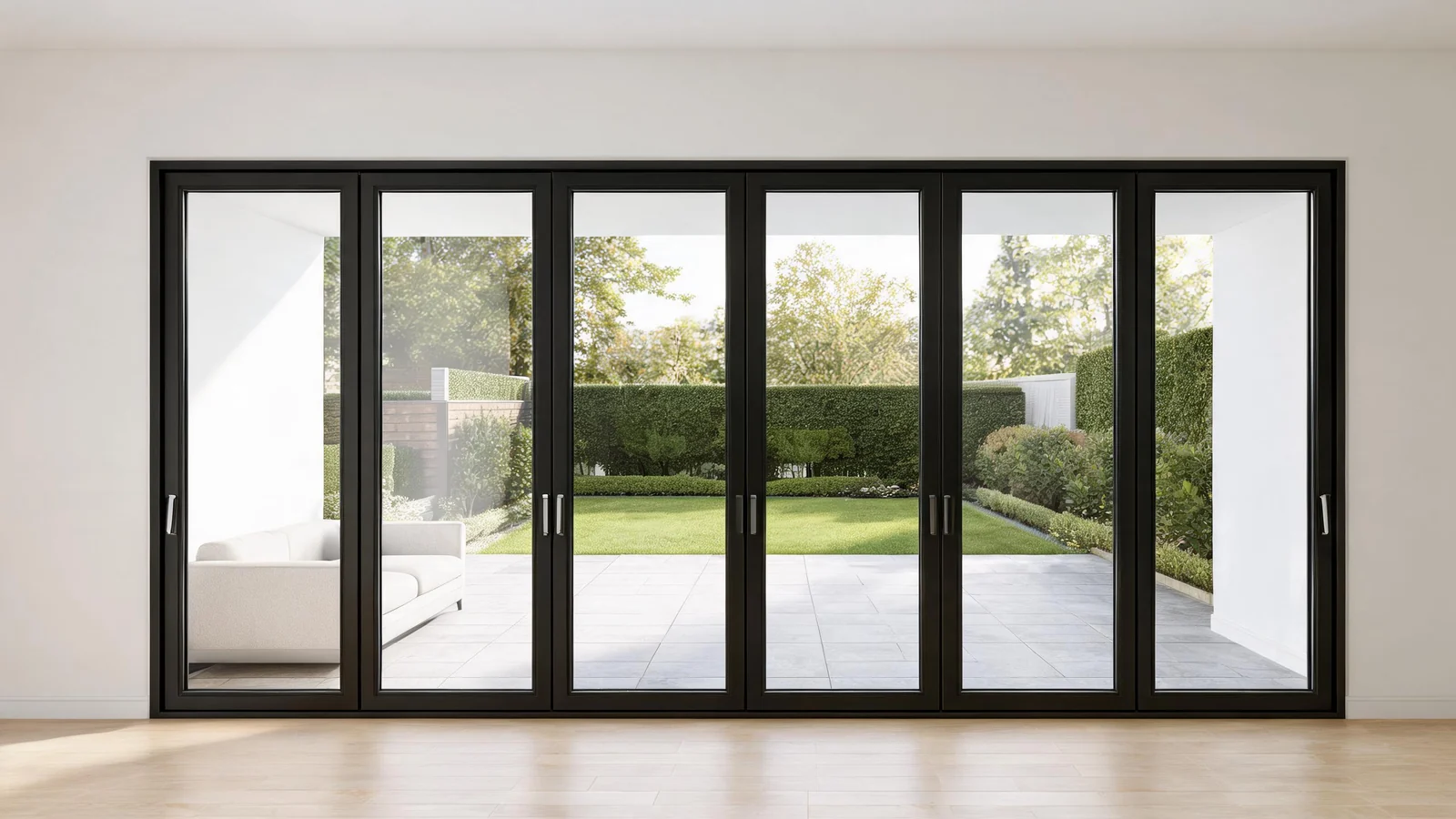
You have a drawing, maybe a rough sketch of an opening, and three quotes for aluminium bifold doors prices. One is low, one is high, one is in between. At first glance they all say they are for the same thing. But are they? When you put the quotes side by side, you notice one has a four-panel layout and another has five. One includes an aluminium threshold, another just says 'threshold as required'. The install line on one quote is blank, on another it is a lump sum with no explanation. That is where the real comparison starts. You are not comparing prices, you are comparing scopes of work and specifications. This guide gives you a practical way to sort that out before you commit. Put another way, an aluminium bifold doors cost figure only means something once you know what each quote includes.
For broad price factors like size, configuration, glass type and hardware options, you can refer to the pricing overview. Here we focus on the line-by-line comparison. By the end you will have a worksheet you can fill in and a short list of questions to send back to each supplier.
Build a baseline before you look at any number
A quote is only useful if it is compared against a fixed idea of what you need. Write down the basics on one page. The opening width and height, from structural edge to structural edge. The number of panels you want, and how they should fold. The direction of travel, left stack or right stack, or a split stack. The threshold type: flush, low, or standard. The glass spec if you have one: double glazed, tempered, low-E, or a specific combination. The finish: anodized, powder coated, or a specific RAL colour. The hardware: a particular brand, like the Kinlong option often quoted on the 88 series, or an equivalent you are willing to accept. Write down what is negotiable and what is not. If you do not have this baseline, you will compare a no-threshold quote against a low-threshold quote and never know why one is cheaper.
Your baseline is also your vulnerability check. If you do not know your opening dimensions precisely, you cannot compare panel counts. A supplier might quote a five-panel layout because it thinks your opening is 4 metres wide. Another quotes four panels because it assumes 3.5 metres. Both could be wrong. Get the dimension right first. Use a laser measure, not a tape, and measure in three places, top, middle, bottom. If the opening is out of square, note that. Your baseline should include a tolerance or a note that the supplier must verify on site. This is not about distrust. It is about buying a custom product that cannot be returned easily.
Panel layout is not cosmetic, it drives cost and operation
The biggest cost difference between aluminium bifold door quotes is often the number and size of panels. A quote with five narrower panels will require more hardware, more hinges, more track, and more labour than a four-panel layout. But that is not the only consideration. A five-panel configuration can reduce the stacked depth when the doors are open, giving you more clear opening. A four-panel layout might have a single large panel that is harder to operate and heavier on the pivot. The panel layout is a design decision, not just a price decision.
When you compare quotes, list the panel layout in your worksheet. Each quote should specify: the number of panels, the width of each panel, the number of folding points, the direction of fold, and the hinge locations. If a quote does not state panel widths, you cannot verify whether the door will fit your opening. Ask for a marked-up elevation. This is a simple drawing that shows the panel arrangement. WANJIA Hiseng can provide configuration drawings for their 88 series folding doors based on your project details. That does not mean the price is fixed, but it gives you something concrete to compare.
A common trap is accepting a lower quote that changes the panel layout from what you wanted. For example, you asked for four equal panels, but the cheap quote is for two large and two small panels. This changes the way the door folds and the look when closed. It might be acceptable, but it should be your choice, not the supplier's quiet substitution. Your worksheet should have a column for 'layout deviation' and you should mark any quote that does not exactly match your baseline.
The threshold question: what is included, what is extra
The threshold is one of the most misunderstood parts of a bifold door quote. A low threshold gives you a nearly flush transition between inside and outside, important for wheelchairs, prams, or just aesthetics. A standard threshold is cheaper but creates a visible step. A flush threshold might require additional floor preparation or a drainage channel that is not included in the door price. Some quotes include the threshold in the door unit price, others list it as a separate line, and some omit it entirely because they assume you will build your own sill on site.
When comparing aluminium bifold doors prices, you need to know exactly what the threshold includes. Is the sill part of the frame kit? Does it have a thermal break? Is there a drainage accessory included, or is that separate? If the door is being installed over a timber deck or a concrete slab, the threshold requirements change. A waterproofing tray or sill pan may be needed, and that is often supplied by the builder, not the door supplier. Clarify this before you compare the bottom line.
Your worksheet should have a section called 'threshold and sill'. For each quote, note the threshold type, whether it is included, whether it is thermally broken, and what additional waterproofing or drainage is required by the installer. If a quote does not mention the threshold at all, that is a red flag. It does not mean the quote is dishonest, but it means the quote is incomplete. You will have to ask for a revision, and that takes time. Better to ask before you ask for the final price.
Freight, installation and the unlisted items that change the total
The price of the door unit is only part of the total cost. Freight can vary widely depending on where the supplier is located, the size of the shipment, and whether it is curb side delivery or white glove. Installation is another line that is either included, excluded, or estimated. Some suppliers quote a supply-only price, which is fine, but then you have to find an installer. Others include installation in the lump sum, which is convenient but can hide a high labour cost. You need to separate these items.
Other unlisted items include: the handle pack, the drop bolts, the multi-point lock, the hinge covers, the track covers, the glass, the glazing beads, the fixings, the sealant, and the expanding foam tape. Yes, some suppliers quote the door frame without the glass, because they assume you will buy glass locally. Others quote the full kit. If you do not check, you might order a door, get it delivered, and then discover you have to buy glass and hardware separately. That is not a mistake by the supplier, it is a different supply model. This is where aluminium bifold doors cost stops being one number and becomes a list of decisions.
For WANJIA Hiseng, the standard 88 series can be configured with Kinlong hardware, but alternative hardware brands can be quoted. Confirm what is included in each quote. The hardware line should specify the brand, the number of hinges per panel, the type of lock, and the handle finish. If it just says 'hardware included', ask for a breakout. You are not being difficult, you are preventing a surprise on delivery day.
Freight should be quoted as a separate line with an estimated delivery point. If you are comparing two quotes, one with freight and one without, you have to add freight to the latter to make a fair comparison. The same applies to installation. A cheap door that costs you two days of a local installer's time might end up more expensive than a slightly dearer door that includes installation. Your worksheet should have a column for 'known delivery and installation cost' where you can plug in your own estimates if the supplier does not quote them.
Installation scope is another source of confusion. Does the installation include removing the old door? Does it include making good the surrounding plaster or brickwork? Does it include adjusting the door after it has settled? Most door suppliers do not include building work in their installation price. They install the frame and leaf, hang the panels, and check the operation. They do not plaster, paint, or tile. If a quote includes a low installation figure, check whether it is just for door hanging or for full finishing. You may need a builder for the finishing work, and that cost should be added to your total.
An original comparison worksheet you can copy now
Here is a practical way to bring all of this together. Create a simple table, either on paper or a spreadsheet, with one row for each supplier and columns for each item. The items are: baseline compliance, panel layout, panel sizes, threshold type and inclusion, glass specification, hardware brand and inclusion, freight, installation scope, and total price including all knowns. Under each column, write what the quote says or write a blank if it is missing. Then add a column for 'question to ask'. This is not a form to send to the supplier, it is for you.
| Quote item | Quote A | Quote B | Quote C |
|---|---|---|---|
| Complies with my baseline | |||
| Panel layout stated | |||
| Panel sizes stated | |||
| Threshold type and inclusion | |||
| Glass specification | |||
| Hardware brand and inclusion | |||
| Freight cost and point | |||
| Installation scope | |||
| Total price with knowns |
You might also use a written decision example, deliberately hypothetical and without measurements or prices. Suppose you have a wide opening facing a garden. You want four panels folding to one side, low threshold, double glazed clear glass, dark grey finish. Quote A matches your baseline and includes Kinlong hardware, freight to your nearest port, and a low aluminium threshold. Quote B is lower but has five panels, standard threshold, and no hardware. Quote C is higher but includes installation and a different hardware brand. Your worksheet shows that Quote A is the only one that meets your spec. Quote B requires you to add hardware, change the threshold, and accept a different layout. Quote C includes installation but you have to verify the hardware. The cheapest is not the best value; the one that matches your spec and has the fewest blanks is easier to evaluate. That is the point of the worksheet.
Energy performance is another trait you can compare if the quotes include glazing data. The National Fenestration Rating Council states that NFRC labels provide ratings for U-factor, solar heat gain coefficient, and visible transmittance, which allow you to compare glass and door configurations on an equal basis. Lower U-factor means less heat transfer, and SHGC tells you how much solar heat the glass admits. The U.S. Department of Energy notes that frame, glazing, and thermal breaks all affect heat transfer, so a quote that gives you a door with a thermal break and low-E glass will perform differently from one that does not. If your quotes do not include energy data, ask for the specific glazing make-up and whether the frame has a thermal break. You can then compare quotes on more than just the panel count.
What to send next, and then stop
Once your worksheet is filled in as much as possible, write a short email to each supplier. Attach your opening dimensions, your desired panel layout, your threshold preference, and your baseline spec. Ask for a revised quote that explicitly confirms each line item. Ask for a marked-up elevation drawing and a list of what is not included. If you have questions about the 88 series from WANJIA Hiseng, send them the project details and ask for configuration guidance. They can discuss custom configurations and provide installation guidance remotely. Do not ask for a discount before you have a complete quote. First get clarity, then compare totals, then decide.
For the measuring side, you can use the method in the article on how to measure for bifold doors. That will help you produce a dimension sheet that suppliers can quote against. Remember that the unit price for aluminium bifold doors prices is not the end of the story. The total cost includes the frame, the glass, the hardware, the threshold, the freight, the installation, and the finishing work. Once you have a worksheet with all of those items, you can decide which quote is truly lower, and why.